
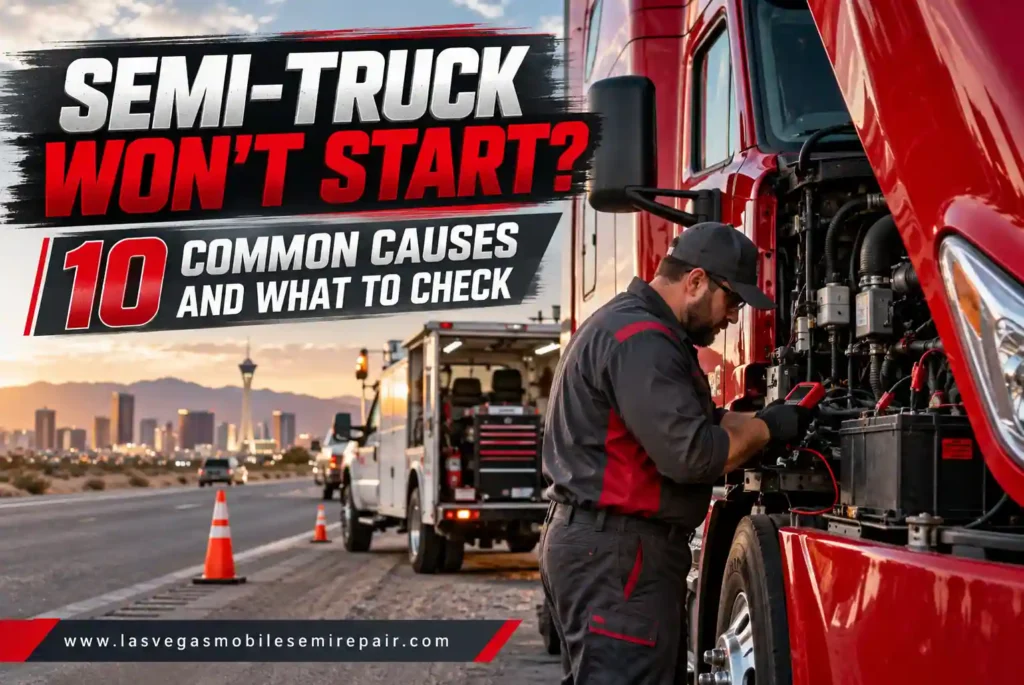
A semi truck that will not start can quickly turn into lost time, delayed deliveries, and unexpected repair costs. Whether the truck fails to crank completely or the engine turns over but refuses to start, several mechanical and electrical problems could be responsible.
Some causes are relatively simple, such as a weak battery or loose cable. Others may involve the starter, alternator, fuel system, sensors, or engine electronics.
Knowing what to check can help you describe the problem accurately and decide when professional mobile semi truck repair is needed.
Here are 10 of the most common reasons a semi truck will not start and what you should check.
1. Weak or Dead Batteries
Battery problems are among the most common reasons a semi truck will not start.
Commercial trucks often use multiple batteries to provide enough power for starting the diesel engine. If one or more batteries are weak, damaged, or discharged, the starter may not receive enough power.
Signs of a Battery Problem
Watch for symptoms such as:
- Slow engine cranking
- Clicking when turning the key
- Dim dashboard lights
- Electrical systems not working
- No response when attempting to start
Check the battery terminals for corrosion, looseness, or damaged cables.
If the batteries repeatedly lose their charge, another problem such as an alternator failure may be responsible.
2. Loose or Corroded Battery Connections
Sometimes the batteries are fine, but electricity cannot flow properly because of poor connections.
Corrosion around the battery terminals can reduce electrical current. Loose cables can produce similar symptoms.
Visually inspect the terminals and cables for corrosion, damaged wiring, or loose connections.
Battery systems in heavy-duty trucks carry significant electrical current, so avoid performing repairs unless you understand the proper safety procedures.
A qualified diesel mechanic can test the batteries, cables, and connections to determine whether the electrical supply is causing the starting issue.
3. Faulty Starter Motor
The starter motor turns the engine when you attempt to start the truck.
If the starter fails, you may hear a clicking sound without the engine turning over. In some situations, there may be no response at all.
Common starter-related symptoms include:
- Clicking noises
- Intermittent starting problems
- Slow cranking
- No engine rotation
- Burning smell near electrical components
Starter problems can sometimes be confused with battery problems. Testing the starting system is usually the best way to identify the actual cause.
4. Alternator Failure
The alternator charges the truck’s batteries while the engine is running and supplies power to electrical systems.
If the alternator stops charging properly, the batteries can gradually lose power until the truck shuts down or will not restart.
Possible warning signs include:
- Battery warning light
- Dim headlights
- Electrical accessories acting strangely
- Repeated dead batteries
- Truck losing electrical power while driving
Replacing the batteries alone may provide only a temporary solution if the alternator is the real problem.
A technician can test charging-system voltage to determine whether the alternator is operating correctly.
5. Fuel System Problems
A diesel engine requires a steady fuel supply to start and operate.
If fuel cannot reach the engine correctly, the truck may crank normally without starting.
Possible fuel-system problems include:
- Low or empty fuel tank
- Clogged fuel filter
- Air entering the fuel system
- Faulty fuel pump
- Damaged fuel lines
- Injector problems
Start by confirming that the truck actually has sufficient fuel. A malfunctioning fuel gauge can occasionally provide an incorrect reading.
If the engine continues cranking without starting, professional fuel-system diagnostics may be necessary.
6. Clogged Fuel Filter
The fuel filter prevents contaminants from reaching the engine.
Over time, the filter can become clogged and restrict fuel flow. When the restriction becomes severe, the engine may experience reduced power, hard starting, or complete failure to start.
Other symptoms may include:
- Rough engine operation
- Loss of acceleration
- Engine hesitation
- Difficulty starting
- Engine stalling
Following the manufacturer’s recommended filter replacement schedule can help reduce the risk of fuel-flow problems.
7. Faulty Crankshaft or Camshaft Sensor
Modern semi trucks depend on electronic sensors to control engine operation.
Crankshaft and camshaft position sensors provide important information to the engine control module. If one of these sensors fails, the computer may not know when to inject fuel or perform other necessary engine functions.
The engine may crank normally but fail to start.
Sensor problems can also cause:
- Check engine lights
- Intermittent starting
- Engine stalling
- Poor performance
- Diagnostic trouble codes
Because these symptoms can resemble other mechanical problems, professional diagnostic equipment is often required to identify the failed component.
8. Blown Fuse or Faulty Relay
A small electrical component can sometimes prevent an entire truck from starting.
Fuses and relays help control systems such as the starter, fuel pump, ignition circuits, and engine control module.
A blown fuse or failed relay may interrupt power to one of these essential systems.
Check the appropriate fuse panel according to the truck manufacturer’s instructions. If the same fuse continues blowing after replacement, do not keep replacing it.
Repeated fuse failure usually indicates an electrical problem that should be diagnosed by a professional.
9. Air Intake or Engine Management Problems
Diesel engines need the correct combination of air and fuel to operate.
Problems involving the air intake, sensors, electronic controls, or emissions equipment may cause difficult starting or prevent the engine from running properly.
Possible causes can include:
- Restricted air filter
- Faulty intake sensor
- Damaged wiring
- Engine control module problems
- Emissions-system faults
Dashboard warning lights or diagnostic codes can provide important clues.
A mobile diesel technician can connect diagnostic equipment to the truck and identify stored fault codes before replacing parts unnecessarily.
10. Cold Weather or Engine Oil Problems
Although extreme cold is less common in Las Vegas than in many parts of the country, semi trucks traveling between states may experience difficult starting in colder climates.
Diesel fuel, batteries, and engine oil can all behave differently at low temperatures.
Thick engine oil increases the effort required to crank the engine, while cold temperatures also reduce battery performance.
Using the correct oil viscosity and maintaining healthy batteries can help reduce cold-start problems.
If a truck continues having difficulty starting even in normal temperatures, the cause should be investigated further.
What Should You Check First When a Semi Truck Won't Start?
When your semi truck refuses to start, begin with the simplest observations.
Check:
- Whether dashboard lights turn on
- Whether the engine cranks
- Whether you hear clicking
- Battery connections
- Fuel level
- Warning lights
- Visible leaks or damaged wiring
- Any recent starting or performance problems
The difference between “the engine does not crank” and “the engine cranks but does not start” is especially important.
If the engine does not crank, the problem may involve the batteries, starter, cables, relays, or electrical system.
If it cranks normally but does not start, fuel delivery, sensors, engine electronics, or other mechanical issues may be involved.
When Should You Call a Mobile Diesel Mechanic?
You should consider professional assistance when basic checks do not reveal the problem or when specialized testing is required.
Modern commercial trucks have sophisticated electrical and engine-management systems. Replacing parts without proper diagnosis can increase repair costs without solving the problem.
A mobile diesel mechanic in Las Vegas can come to your truck’s location, inspect the starting and charging systems, scan for diagnostic trouble codes, and determine what repairs may be needed.
Mobile service can be particularly valuable when the truck is disabled at a parking lot, truck stop, fleet yard, warehouse, or roadside location.
Avoiding Future Starting Problems
Preventive maintenance can reduce the likelihood of unexpected starting failures.
Have the following systems inspected regularly:
- Batteries
- Battery cables and terminals
- Alternator
- Starter
- Fuel filters
- Fuel lines
- Electrical wiring
- Belts and connections
- Engine sensors
- Diagnostic fault codes
Pay attention to slow cranking, repeated battery problems, unusual warning lights, or difficulty starting.
These symptoms may provide an early warning before the truck becomes completely disabled.
Get Help When Your Semi Truck Won't Start
When a semi truck will not start, the problem could be as simple as a weak battery or as complex as an electrical, fuel-system, sensor, or engine-management failure.
Start by checking obvious issues such as battery power, connections, fuel level, and dashboard warnings. If the cause is not clear, professional diagnostics can help prevent unnecessary repairs and additional downtime.
Las Vegas Mobile Semi Repair provides mobile truck repair and diesel repair services for commercial vehicles in the Las Vegas area. If your semi truck will not start, contacting an experienced mobile technician can help you identify the problem and determine the right repair.