
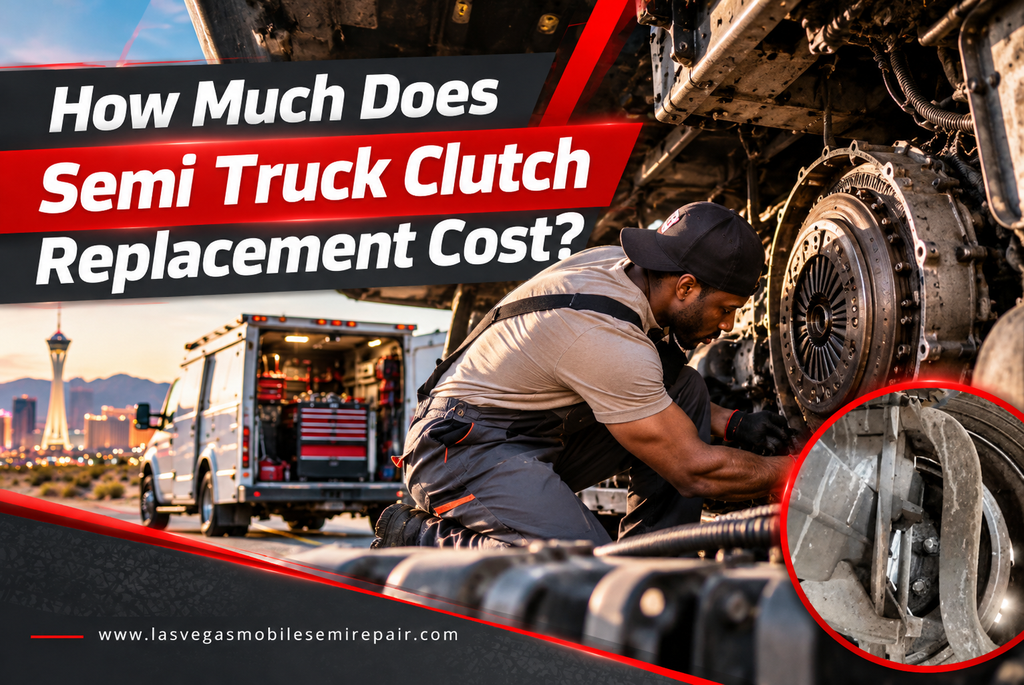
A failing clutch can quickly turn a routine delivery into an expensive breakdown. If your semi truck is slipping, struggling to shift or losing power under load, you may be wondering how much it will cost to replace the clutch and get back on the road.
Understanding semi truck clutch replacement cost helps owner-operators and fleet managers budget for repairs and avoid unexpected expenses. The total depends on your truck, clutch type, labor requirements and whether components such as the flywheel also need attention.
This guide covers estimated 2026 replacement prices, the factors affecting your repair bill, signs of clutch failure and options for truck drivers in Las Vegas.
QUICK ANSWER
$2,800 to $6,500 This is a broad U.S. planning range, not a quote from Las Vegas Mobile Semi Repair. The company charges $300 for a normal service call including the first hour, $400 for a weekend/after-hours service call, and $175/hour for labor during both regular and after-hours service. A clutch quote depends on the parts, actual hours and related repairs.
Semi Truck Clutch Replacement Cost Breakdown
Replacing a heavy-duty clutch involves considerably more than installing a new friction disc. A mechanic generally needs to separate the transmission from the engine, remove the worn assembly and inspect related components.
| Replacement component | Estimated cost |
| Heavy-duty clutch kit | $800 to $2,200 |
| Labor for 8 to 12 hours, including the $300 standard call and its first hour | $1,525 to $2,225 |
| Flywheel resurfacing, if needed | $200 to $400 |
| New flywheel, if required instead | $600 to $1,200 |
| Typical complete replacement | $2,800 to $6,500 |
Note: These are illustrative U.S. parts and total-cost planning figures, combined with Las Vegas Mobile Semi Repair’s confirmed standard-hours labor rate for the 8-to-12-hour example. The $300 standard call includes hour one; each additional hour is $175. Weekend and after-hours calls are $400, while the hourly rate remains $175. Prices vary with the job; individual ranges are not necessarily additive.
For example, with a $1,300 clutch kit, 10 hours of regular-hours labor would cost $1,875 ($300 for the call and first hour, plus nine additional hours at $175). Add $300 in flywheel resurfacing and $250 in additional materials for a hypothetical total of $3,725 before any applicable taxes or other approved charges. This example is not an actual estimate for a particular truck.
What Affects Heavy-Duty Truck Clutch Replacement Cost?
1. Truck Make and Model
Your truck’s engine, transmission and chassis configuration influence how easily a mechanic can access the clutch. Freightliner, Peterbilt, Kenworth, Volvo, Mack and International trucks may require different components and labor procedures. Two trucks with similar mileage can therefore receive different estimates. The correct clutch must also match the vehicle’s engine torque and transmission specifications.
2. Clutch Type and Parts
A standard manual-transmission clutch may have different parts and installation requirements from a self-adjusting or automated manual transmission clutch. The price can vary according to the manufacturer, torque capacity, parts availability and required installation kit. Choosing a compatible, correctly rated clutch is more important than purchasing the cheapest available assembly.
3. Labor and Transmission Removal
Labor is a major contributor to semi truck clutch replacement cost. A conventional replacement may take approximately 8 to 12 labor hours. At Las Vegas Mobile Semi Repair, the normal service call is $300 and includes the first hour, followed by $175 for each additional labor hour. That is $1,525 to $2,225 for an 8-to-12-hour regular-hours job, before parts or other charges. A weekend or after-hours service call is $400, but the hourly labor rate remains $175. Actual labor time can change if transmission access is difficult, fasteners are damaged or other problems are found.
4. Flywheel Condition
Your flywheel should be inspected when replacing the clutch. Heat damage, cracking, scoring or excessive wear can affect engagement and shorten the life of a new clutch. Depending on its condition and the manufacturer’s specifications, the flywheel may require resurfacing or complete replacement. Ask whether flywheel inspection and any necessary machining are included in your initial estimate.
5. Additional Components and Repairs
Clutch replacement also creates an opportunity to inspect parts that would otherwise require substantial disassembly to reach. These can include the pilot bearing, release mechanism, clutch brake, linkage and transmission input components. Oil leaks from the rear main seal should also be investigated when relevant.
Can You Repair a Semi Truck Clutch Instead of Replacing It?
Not every clutch problem requires a complete replacement. Clutch adjustment, linkage problems, a defective release component or an issue with the clutch brake can sometimes produce symptoms similar to those of a worn clutch.
A proper inspection can help distinguish an adjustment problem from worn friction material or internal damage. If the clutch is severely worn, contaminated or mechanically damaged, replacement may be necessary. Paying for repeated adjustments is unlikely to be economical when the assembly has reached the end of its usable life.
Signs Your Semi Truck May Need a New Clutch
Recognizing clutch problems early can help reduce the risk of a breakdown and further mechanical damage. Common warning signs include:
- Engine RPM increases without a corresponding increase in road speed.
- Difficulty engaging gears or repeated gear grinding.
- Shuddering, vibration or jerking during engagement.
- A burning smell after clutch slippage.
- An unusual clutch pedal feel or engagement point.
- Reduced ability to transfer engine power when hauling heavy loads.
These symptoms do not automatically confirm clutch failure. Transmission faults, release-system problems and other drivetrain issues can produce similar behavior.
If your truck is experiencing these symptoms, arrange a professional transmission and clutch inspection rather than continuing to operate it until the problem becomes severe.
What Happens During a Professional Clutch Replacement?
A professional clutch replacement generally follows five stages:
- Initial diagnosis: The mechanic checks the clutch symptoms, pedal or actuator operation, linkage and relevant transmission functions to determine the probable cause.
- Transmission removal: Where replacement is necessary, the mechanic safely supports and separates the transmission to gain access to the clutch assembly.
- Inspection of related components: The flywheel, pilot bearing, input components, release mechanism and nearby seals are inspected for wear or damage.
- Clutch installation: The compatible clutch and any authorized additional parts are installed following the manufacturer’s specifications.
- Adjustment, calibration and testing: The mechanic performs the applicable adjustments or electronic calibration and verifies clutch engagement and shifting before returning the truck to service.
The exact procedure varies by truck and transmission type. A complete replacement requiring substantial lifting equipment may need to be performed at a properly equipped repair facility.
Mobile Semi Truck Clutch Repair in Las Vegas
Clutch trouble can occur at a truck stop, loading dock, distribution center or while traveling through Las Vegas. A mobile mechanic can assess the symptoms and determine whether an on-site repair is practical. Problems involving linkage, adjustments or other accessible components may be suitable for mobile service.
However, a complete clutch replacement requires substantial transmission-handling equipment. Whether that work can be completed at your location depends on safe access, available tools, site conditions and the extent of the repair.
Las Vegas Mobile Semi Repair provides mobile truck repair and roadside assistance in Las Vegas and surrounding areas. Its dedicated transmission and clutch repair service includes clutch diagnostics, adjustment and replacement.
For problems that might originate elsewhere in the powertrain, the company also offers driveline repair and diagnostics and electrical system repair.
How to Avoid Unnecessary Clutch Replacement Expenses
A substantial repair bill makes accurate diagnosis and a detailed estimate especially important. Before authorizing replacement, request an itemized quote identifying the $300 standard service call (including its first hour), or the $400 weekend/after-hours call if applicable, estimated additional labor at $175/hour, the clutch kit, flywheel work and other required components. Ask which extra repairs need approval and what warranty applies to the completed work.
Regular inspections, correct clutch adjustment where applicable and avoiding prolonged clutch slipping can help reduce unnecessary wear. Do not use the clutch to hold a loaded truck stationary on an incline.
If you manage a fleet, keep service records and investigate recurring clutch problems. Premature failures may indicate an operating, adjustment or component-compatibility issue rather than ordinary wear alone.
Conclusion: Get Your Semi Truck Clutch Inspected Before Replacing It
A complete clutch replacement can be a significant maintenance expense. Broad 2026 industry planning estimates commonly range from $2,800 to $6,500, but they are not Las Vegas Mobile Semi Repair’s fixed prices. The company’s standard $300 service call includes the first labor hour; weekend and after-hours calls are $400, and the labor rate is $175/hour at all times. An accurate diagnosis determines whether replacement is needed and what the final quote includes.
If your truck is slipping, grinding gears or struggling under load, contact Las Vegas Mobile Semi Repair to discuss the symptoms and available repair options. Call (702) 830-3762 to request clutch repair assistance in Las Vegas.
Frequently Asked Questions
A conventional heavy-duty clutch replacement may require approximately 8 to 12 labor hours. At Las Vegas Mobile Semi Repair, a standard-hours call is $300 including the first hour, plus $175 for each additional hour. An 8-to-12-hour regular-hours job therefore has an illustrative service-call-and-labor cost of $1,525 to $2,225, before parts and other charges. The weekend/after-hours service call is $400, while the hourly rate stays at $175. Actual time depends on transmission access, the clutch type and any additional repairs.
Repair or adjustment generally costs less when the problem involves an accessible component and the clutch itself remains serviceable. However, replacing a severely worn or damaged clutch is often more practical than repeatedly attempting temporary fixes. The appropriate decision depends on the results of a mechanical inspection and the condition of the complete clutch system.
Clutch lifespan varies considerably according to truck configuration, operating conditions, hauling weight, driving habits and maintenance. Long highway journeys and frequent stop-and-go operation place different demands on the clutch. There is no single replacement mileage that suits every truck. Scheduled inspections and attention to early symptoms are more useful than relying on mileage alone.
Some clutch repairs and adjustments can be performed on-site. A complete replacement, however, involves safely supporting and removing heavy transmission components. Whether mobile replacement is feasible depends on the truck, the repair location and the equipment available. A mobile mechanic can inspect the problem and determine whether the work should be performed at your location or a repair facility.
Flywheel inspection should be part of the repair process, but resurfacing or replacement is not necessarily included in every quoted price. A mechanic should inspect the surface for heat damage, cracks and excessive wear. The condition of the flywheel and the manufacturer's specifications determine whether it can be reused, resurfaced or must be replaced.
Continuing to operate a truck with significant clutch slippage can generate excessive heat, damage components and eventually prevent the truck from moving. It may also create a safety risk, particularly when hauling a heavy load. If the clutch slips badly or the truck cannot engage gears reliably, stop somewhere safe and arrange professional assistance instead of continuing the trip.
Provide the repair company with your truck's make, model, year, VIN, engine and transmission details if available. Explain the symptoms, when they started and whether the truck remains operational. Your current location also matters when requesting mobile assistance. These details help the mechanic identify suitable parts and assess the likely labor and equipment requirements.