
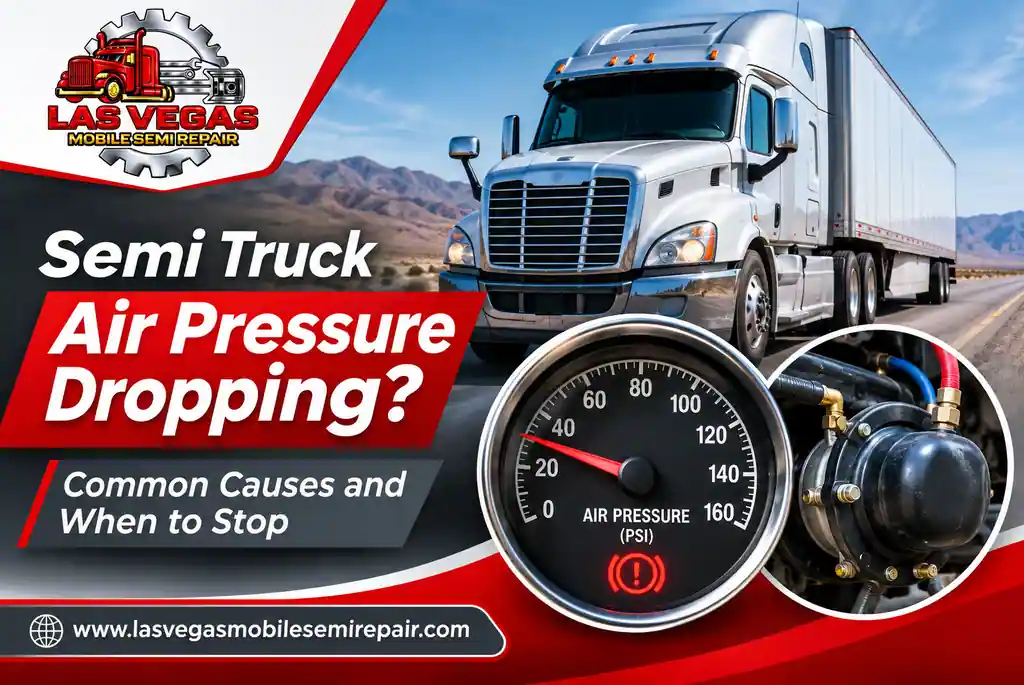
If your semi truck’s air pressure is dropping while driving, treat the change as a potential brake-system problem, not a minor dashboard annoyance. Air brakes rely on adequate compressed air to operate correctly. An active low-air warning, rapidly falling gauges, or brakes behaving abnormally means you should stop safely as soon as possible and obtain professional help. Do not wait for spring brakes to apply automatically.
The problem may come from a leaking hose or fitting, but a failing compressor, valve, brake chamber, or trailer connection can produce similar symptoms. Knowing the patterns helps you describe the issue to a technician without guessing at a repair.
How a Normal Air-Brake System Behaves
A compressor fills reservoirs; a governor controls the compressor’s operating cycle; valves and lines deliver air where it is needed. Drivers typically see primary and secondary air-pressure gauges. During normal operation, pressure changes as the brakes are applied and the compressor cycles. A repeated failure to recover, unusually fast loss, or warning buzzer is different.
The commercial vehicle air-pressure warning requirements address the need for a functioning warning system. Many modern air-braked commercial vehicles use low-pressure warnings around 60 psi, but drivers must follow the specifications of their own equipment. Do not treat a number from another truck as permission to continue driving.
Common Reasons Air Pressure Keeps Falling
Leaking air lines, fittings, or gladhand seals
Loose fittings, abraded hoses, aged rubber seals, or damaged tractor-to-trailer connections can release air. A steady hiss near the trailer connections is a useful clue, but noise alone cannot measure how severe the leak is. Federal brake hose and connection rules require appropriate routing and leak-free connections.
Damaged brake chamber or control valve
Air escaping from a brake chamber, relay valve, or quick-release valve may become more noticeable when the service brakes are applied. These components are part of a safety-critical system. Never open a spring-brake chamber or attempt an improvised line repair at the roadside.
Compressor, governor, or air-dryer trouble
If the system struggles to build pressure even without obvious leakage, the fault may involve compressor output, an air governor, the air dryer, or the supply side. A technician can separate an air-production problem from air loss by testing the system rather than replacing parts based on a sound.
Trailer-side air problems
A trailer leak may appear only after the combination is connected and charged. Failed trailer hoses, reservoirs, brake chambers, or valves can change how both vehicle systems behave. Document whether the problem occurs bobtail or only with the trailer attached.
What Different Air-Loss Patterns May Suggest
Pressure that drops mainly with the foot brake applied may point toward service-brake circuitry, while loss with the brakes released may involve a different part of the supply system. A gauge that never climbs to normal pressure can suggest a production problem, excessive leakage, or both. These are clues for dispatch and the mechanic, not reliable diagnoses. Never conduct an improvised road test to reproduce dangerous symptoms.
When Should the Driver Stop?
Stop in a safe location immediately when the low-air warning activates, reservoir pressure falls unusually quickly, the truck cannot hold suitable air pressure, or the brakes react abnormally. Do not wait until a spring brake applies, because that can create loss of control or a long and unpredictable stop.
Federal unsafe-operation rules prohibit operation of a vehicle in a condition likely to cause an accident or breakdown, with a narrow safety-based exception. The existence of that exception is not a general license to drive a truck with failing brakes. If conditions are unsafe, obtain roadside assistance or recovery.
What Can You Check Without Making the Situation Worse?
Once parked securely, note current gauge readings, whether the loss happens with brakes applied or released, and where any hissing seems to originate. Watch for visible damage from a safe position. Share observations with dispatch, but leave pressure tests, chamber work, and disconnection of charged lines to qualified personnel.
Las Vegas Mobile Semi Repair describes mobile brake repair services and 24/7 roadside support for air-line problems. A technician can examine the full air system, identify the failed component, and verify operation after repair.
How to Reduce Recurring Air Loss
Conduct appropriate pre-trip air-system checks, listen for new leaks during inspections, keep gladhand seals in suitable condition, and document recurring issues. Preventive checks should include hoses near moving suspension parts and areas exposed to abrasion or heat. A repeated leak deserves diagnosis even if the compressor seems able to keep up while the engine runs.
Fleet managers should preserve the defect report and repair record so recurring faults can be recognized. A temporary recovery in pressure does not prove that a safety-related problem has gone away.
Conclusion: Have a Dropping Air-Pressure Problem Checked
Falling air pressure can signal anything from a worn fitting to a major brake-system malfunction. The right response is to stop safely, describe the symptoms accurately, and have the system inspected before resuming service. Drivers in the Las Vegas area can contact Las Vegas Mobile Semi Repair at (702) 830-3762 for mobile diagnostic and repair assistance. Safety matters more than keeping an already unstable air system moving.
Frequently Asked Questions
Some pressure change is expected during brake applications. Rapid, continuing, or excessive loss is not and requires inspection.
It indicates that air pressure has reached a warning threshold. Stop safely rather than trying to finish the trip.
Yes. Damaged seals or loose connections can lose air, although other faults may produce similar symptoms.
A running compressor may temporarily replenish lost air. That does not make a leaking brake system safe.
The leak may be in a service-brake circuit, chamber, or control component. A technician must isolate the cause.
No. Location, ambient traffic noise, and operating conditions can make a leak hard to hear.
Yes. Compare symptoms with and without the trailer only through safe, approved professional testing.
No. Improvised repairs are not an acceptable substitute for approved brake-system components and installation.
No. Proper system testing includes pressure behavior, leak checks, and functional brake inspections.