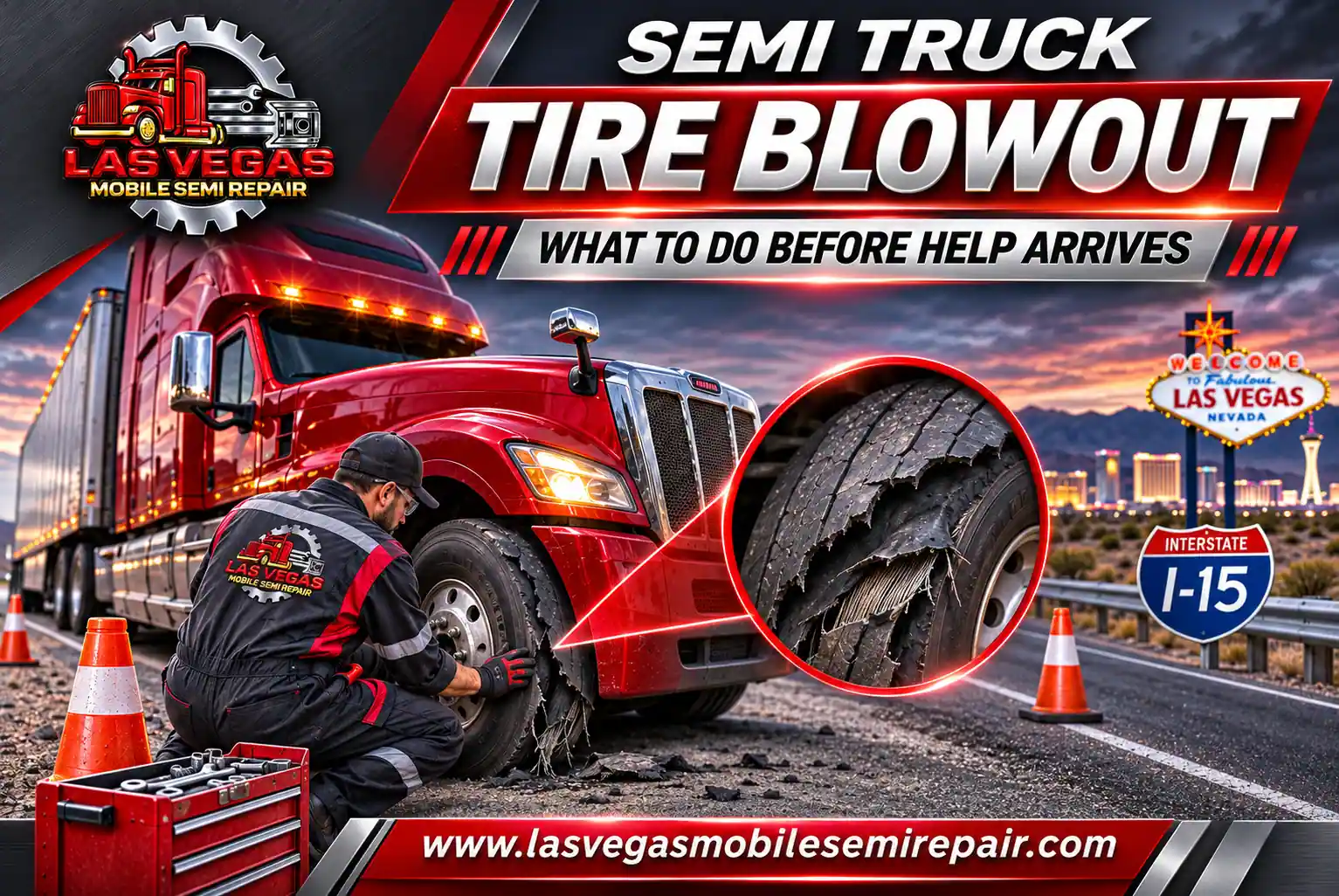
A semi truck tire blowout on I-15 can change how the truck handles in seconds. Your first priority is to keep the rig under control, slow smoothly, and reach a safer stopping location without sharp steering or sudden braking. Once stopped, protect the scene, tell dispatch exactly where you are, and arrange qualified roadside assistance. A damaged commercial tire should not be driven farther merely to protect a delivery schedule.
Near Las Vegas, heavy traffic, high temperatures, and remote stretches can make an already stressful breakdown more dangerous. The steps below focus on the driver’s immediate decisions, not do-it-yourself tire replacement.
Control the Truck During the First Seconds
Grip the steering wheel firmly and focus on maintaining your lane. A failed steer tire may pull the tractor toward the damaged side; a drive or trailer tire may cause vibration, noise, or debris behind the rig. Ease off the accelerator and allow speed to decrease under control. Avoid panic braking, overcorrecting, or cutting across lanes.
Use mirrors and available sight lines to choose a safe exit or shoulder. A vehicle that is difficult to control, rubbing damaged parts, or scattering debris may need to stop sooner. Your response should always follow safe-driving training and actual road conditions; there is no single maneuver that fits every blowout.
Choose the Safest Available Stopping Location
An exit ramp, truck stop, or wide paved shoulder can provide more room than a narrow lane edge, but do not travel on a failed tire if doing so creates an additional hazard. Stop as far from live traffic as reasonably possible and avoid soft ground or unstable slopes. Keep the combination straight and set the parking brakes when secure.
Switch on hazard warning flashers immediately. The federal rule for stopped commercial vehicles requires flashers when a truck is stopped on a highway or shoulder for reasons other than normal traffic. It also calls for warning devices within ten minutes in applicable situations.
For a divided highway such as much of I-15, the specified warning-device pattern differs from an ordinary two-way road: the rule describes devices toward approaching traffic at 100 and 200 feet, plus one near the vehicle. Always prioritize personal safety; never step into active lanes to place a triangle. Request law enforcement or highway assistance if placement is unsafe.
Protect Yourself and Other Drivers
Stay away from the damaged tire and the traffic-facing side of the truck. A ruptured tire may leave exposed steel cords, damaged wheel components, or loose debris. Do not attempt to retrieve tread fragments from the highway. Wear high-visibility gear if you must exit, follow instructions from responders, and choose the safest protected position available.
If you see smoke, fire, leaking fuel, or a collision, contact emergency services. A tire blowout is not always limited to the tire: rubber can strike brake hoses, lights, fenders, and suspension parts. An inspection should consider those secondary failures before the trip resumes.
Give Roadside Dispatch Details That Matter
Report the interstate number, northbound or southbound direction, closest milepost or exit, and GPS pin if your company can share one. Say whether the failed tire is on the steer, drive, or trailer axle, and provide the tire size if visible without entering a dangerous area. Tell dispatch if the truck blocks a lane or has a low-clearance or narrow-shoulder problem.
The Las Vegas Mobile Semi Repair team advertises emergency roadside service across I-15 and the Las Vegas area. Its mobile repair services include commercial tire replacement. Ask about tire availability and whether roadside conditions allow an on-site repair.
What the Tire Technician Needs to Check
A blown tire must be replaced when its casing is severely damaged. The service provider should confirm the replacement’s load rating and compatibility, inspect the wheel and fasteners, and look for damage to adjacent components. If the blowout affected a dual assembly, its companion tire may have carried additional load and should be evaluated.
Before departing, confirm the wheel is correctly installed and the tire is inflated to the applicable specification. Follow the technician’s and fleet’s requirements for wheel-fastener verification and post-service inspection. If serious mechanical damage remains, the rig should not be released for highway use.
Preventing the Next Blowout
Regular pressure checks with a suitable gauge, correct loading, tire condition checks, and prompt attention to air loss reduce avoidable risk. A tire can be underinflated without looking visibly flat. Watch for irregular wear, sidewall bulges, embedded objects, exposed cords, and heat-related damage.
Do not overlook trailer tires during pre-trip inspections. A truck may feel normal from the cab even when a trailer tire is losing pressure. Use the vehicle manufacturer’s and tire maker’s specifications rather than guessing from the maximum pressure printed on a sidewall.
Conclusion: Roadside Help for an I-15 Tire Emergency
After a blowout, your goal is not simply to get moving quickly. It is to keep the driver safe, make the vehicle visible, and prevent a second failure from overlooked damage. For assistance near Las Vegas, call Las Vegas Mobile Semi Repair at (702) 830-3762 with your exact I-15 location and tire details. If the scene is unsafe, involve highway authorities before a technician approaches the truck.
Frequently Asked Questions
No. Abrupt braking or steering may destabilize a combination vehicle. Keep control and slow progressively according to conditions.
Do not assume it is safe. Additional travel can damage the wheel, brake equipment, or vehicle; stop where the risk is lowest.
Federal rules apply to covered commercial roadside stops. Placement requirements vary by roadway configuration, and personal safety remains essential.
Remain in a protected position, notify dispatch, and request highway or emergency assistance when needed. Never walk into live traffic.
Not necessarily. Call emergency services if there is injury, fire, a crash, blocked traffic, or another immediate threat.
Only if the correct product is available. Share sidewall details and axle position before dispatch to reduce avoidable delays.
Yes. It may have been overloaded or overheated after its partner lost pressure and should be inspected.
Yes. Detached tread can strike nearby air lines and electrical components, so the area needs an inspection beyond the tire.
Only after the failed tire and related damage have been addressed and the truck passes appropriate safety checks.